
ProductJuly 2026 · 4 min read
What’s New in PaidLens: Product Updates.
New features and improvements to help you work smarter and faster.
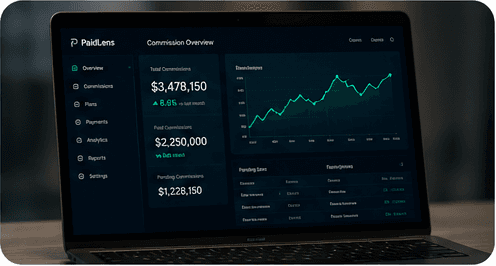
Every PaidLens release is guided by one question: does this make it faster to reach a commission answer that is accurate, explainable, and controlled?
That standard affects more than calculation speed. It includes how teams prepare data, build logic, review changes, investigate results, preserve evidence, and present outcomes to employees.
Here is how the product is evolving across the commission workflow.
A more responsive modelling experience
Commission operators often work with detailed models containing many line items, dimensions, periods, and dependencies. Small delays add up when every configuration change requires repeated navigation or a full recalculation.
PaidLens is improving the modelling workspace so teams can work closer to the speed of thought. More granular saving, persistent workspace context, clearer formula feedback, and progressive loading help users make focused changes without losing their place.
The aim is not visual polish alone. A responsive workspace reduces accidental duplication, makes review easier, and shortens the path between identifying an issue and validating the correction.
Stronger formula and calculation controls
Commission logic must remain dependable as models change. Improvements to typed formula behaviour, dependency validation, and rename handling help protect calculations from references that look valid but no longer point to the intended source.
Calculation workflows are also becoming more deliberate. Draft changes can be preserved before activation, conflicting edits can be detected, and invalid dependencies can stop a calculation rather than silently producing a plausible result.
- Clearer feedback while formulas are created or edited
- Safer handling of renamed model elements
- Validation of dependencies before execution
- Controlled activation of governed calculation logic
Faster investigation from summary to detail
A commission total is useful only when operators can understand what produced it. PaidLens continues to improve the path from aggregated results to the transactions, rules, and adjustments underneath them.
Focused filtering, stable dimensional context, and contributor-level drill-downs help finance investigate without exporting the result into a separate analysis file. Keeping the investigation inside the governed workflow also preserves a clearer relationship between the question and the underlying evidence.
Governance that follows the work
Controls are most effective when they are part of the normal workflow. PaidLens is strengthening how drafts, approvals, roles, inactivity rules, and audit events operate across product areas.
This supports a practical separation of duties: one person can prepare or propose a change, another can review its impact, and an authorised owner can activate or release it. The history stays connected to the object and period affected.
Clearer employee and manager visibility
The employee experience should answer the most common commission questions without exposing administrative complexity. Continued improvements focus on making earnings, supporting activity, adjustments, and status easier to understand.
Managers need a similarly focused view: enough context to coach performance and address questions, while sensitive configuration and cross-team data remain governed by role.
How we evaluate a product improvement
A feature is valuable when it improves the governed user journey, not merely when it adds another control to the interface. We evaluate changes in the context of real tasks: building a rule, tracing a result, approving an exception, returning to unfinished work, or answering an employee question.
That means testing populated states, large models, different roles, and the points where data or dependencies may be incomplete. It also means checking that a faster path does not weaken auditability, access control, or the clarity of the final explanation.
What to expect next
Future releases will continue to connect commission execution with planning, performance analysis, and governed decision support. The priority is a coherent product architecture rather than a collection of disconnected features.
We will keep measuring improvements against operational outcomes: fewer manual handoffs, earlier detection of exceptions, faster investigation, clearer explanations, and stronger evidence for every material change.
Product updates should make the commission cycle feel less like a monthly reconstruction exercise and more like a trusted, continuously managed finance process.